
on finding the one(s)
or, trying and trying again

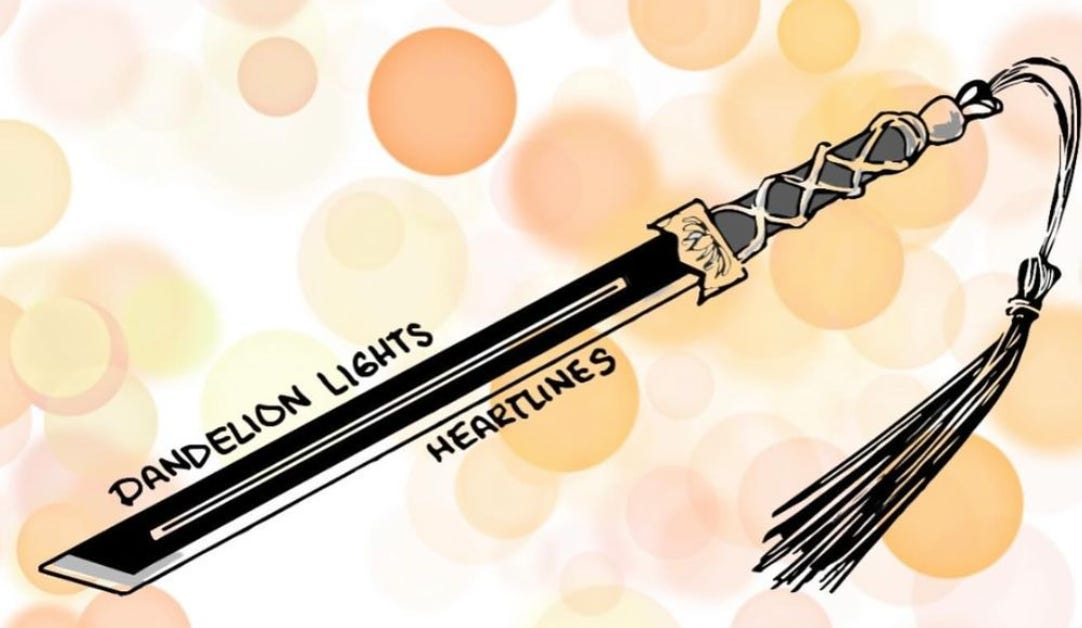
I recently published my short story, “dandelion lights,” in Heartlines Spec. I am extremely proud of this piece, and extremely tired! It took me 1 year and 2 months to sell this story. I was just about ready to place it on the shelf. I will delay the recounting of the victory, because this is how it felt—the process was long.
I’ve been trying to experiment with what it means to write an ace-spectrum story. I don’t just mean, like, a story with ace characters in it, though that is also an ace story, of course. I mean a story with aceness baked into it—not just woven into the tapestry but constructing the very fibers of the threads used to weave that tapestry. What does story structure look like when you’re not hitting the allo romcom beats? What does it mean to decolonize story structure? What does it look like when the character is queer and Asian diaspora? What does a story that blends western elements with wuxia-inspired tropes read like? What does it mean to exist at the intersection of many marginalizations (if you will excuse me complicating the imagery and mixing metaphors)? IS IT POSSIBLE??? *shouts into the void*
I’ve been trying to experiment with what it means to write an ace-spectrum story.
I will not pretend that the story as I submitted it was perfect (I tinkered with it even after acceptance), but I am suspicious that my previous horror short story that was, in some ways, more conventional, or perhaps, more widely understood (Asian girl becomes a monster because of rage against white supremacy) sold so fast with several offers and a Cantonese diasporic ace romance with wuxia mixed in took so many submissions and revisions to get right. To take some more responsibility, I think the challenge was 1) to figure out for myself what writing an ace-spec story meant (if no lightning-strike meet-cute, then what?) 2) to articulate more clearly that the ace-spec aspect (a tongue-twister) was the reason for the quirky structure and that I had thought that through and 3) to embrace the quirky structure and make it shine. And later, 4) to communicate all this to editors during revisions and notes.
I grew antsy after a year of submitting it. And devastated. Perhaps this wasn’t the kind of story people wanted, I started to think. Maybe it’s too weird.
Which, you know, if you’re in the depths of despair, isn’t a far cry from: Maybe I am too weird.
That feeling sucks. I often feel like an outsider in my profession, in my field, even though I am technically an Expert (TM) in it. To feel that way about such a personal story—and such a pleasurable one for me to write too—is to feel not just sad but also exhausted. Hours of efforts, try try try, squeaking out like air from a deflating balloon.
But it only takes one, as they say—or, in this case, two. The amazing editors at Heartlines saw something in this story and accepted it after a revision. Working with them was so pleasant and fun and I realized that I was relieved I hadn’t sold the story to another press. Emily and Rebecca handled the process with such care, attention, and engagement. They got it.
In the last few weeks, people have responded really warmly to this oddball story. AVEN—the resource for asexual folks online—even reposted it on Twitter, which was a huge fangirl moment for me.
Kind of like the main character in my short story, I want to open up portals for community and conversation.
Sometimes I am asked what my “author brand” is, and the cultural critic in me shies away from such blatant self-commodification (this side of me is very at odds with the YA author side; the pressures for SCHOLAR and AUTHOR are diametrically opposed—maybe I’ll write about this some day). A brand aside, I really do want to create an oeuvre of queer diasporic (particularly acespec) stories. How cool would it be to make readers like me feel seen—and readers unlike me widen their imaginations to other ways of being in the world. Kind of like the main character in my short story, I want to open up portals for community and conversation.
It only takes one, they say. But in the long career of a writer, which I hope to have, it’ll be one, and then another, and another, and another, sometimes in unexpected ways and from unexpected places. Just like acespec love, writerly success almost never feels like a lightning strike. Sometimes it feels like meridians (to use a wuxia term) opening up to magic, a gradual process of training and trying for a long time. There are moments of honing a craft in seclusion, there are moments of epic drama and leveling up.
It only takes one, but hopefully one day, there will be many.
I wish you writerly abundance, and communities strong and more to come.